The public can visit Tuesdays and Thursdays
MAYS LANDING – Atlantic Cape Community College has created a butterfly habitat at a vacannt greenhouse on the Mays Landing campus.
Numerous butterfly species today face steep declining numbers due to widespread use of harmful pesticides, habitat loss from overdevelopment and deforestation, and climate change. The impacts are being felt here in Southern New Jersey as well along a key migratory path across the peninsula of Cape May.
After Assistant Professor of Biology Dr. Christopher Carbone introduced the idea of creating an indigenous butterfly habitat, Atlantic Cape Community College Director of Science Labs Dr. Terri–Lynn Hamby decided to do her part to help the local butterfly population by repurposing the vacant Thomas E. Brown Greenhouse on the College’s Mays Landing campus into a full–time butterfly reserve.
The greenhouse, formerly used by the college’s Academy of Culinary Arts to grow herbs and vegetables, was renovated throughout the summer months. Countless hours were spent rehabilitating the greenhouse, restoring potted plant benches, and creating an inviting space for learning and exploration. A dedicated team that included facilities employees Jack Taggart, Tom DiPietro and Lewis Miller, as well as Darla Crompton, Anthony Burgos, Kyre Monroe, Cecilia Yang, and Tracy Nti Amankwah made this dream a reality.

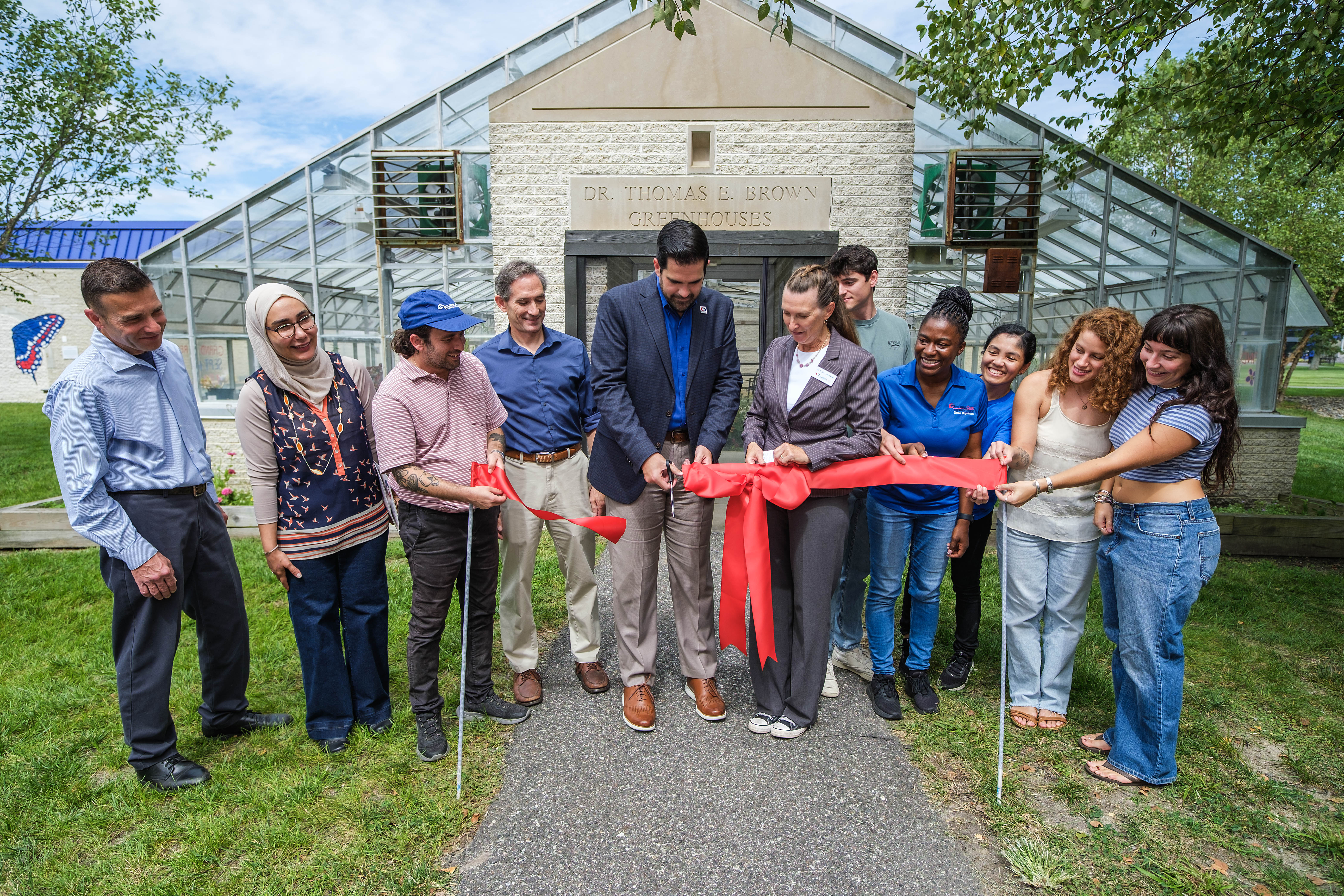
The finished product, designed as a welcoming destination where students can relax, study, engage with nature, and experience hands-on environmental learning, was officially unveiled during a ribbon cutting ceremony on Sept. 10 with more than 50 faculty, staff, students and community members in attendance. Hamby envisions the habitat being used by employees, students and the general public for outreach, engagement and educational purposes to learn more about the butterfly’s life cycle.
Inside, visitors may witness the four stages of creation in real time. Numerous eggs are affixed to the four varieties of milkweed and additional native plants installed to attract and support the local butterfly species. The caterpillars, or larvae, in various stages of growth traverse the greenhouse’s floors and branches as they move from one plant to another in search of tasty leaves from which they quickly blossom to full size.
The magical stage of forming a chrysalis, where the caterpillar transforms into an adult butterfly, typically takes between eight and 14 days, though warmer temperatures may allow the metamorphosis to happen quicker. Some of the greenhouse’s butterflies came to be in as little as four days.

“We currently have monarchs, cabbage white, common buckeye, and painted lady butterflies in the habitat. All of the butterflies that we have, and will have, in the greenhouse are indigenous to our area,” said Hamby, who stated the State of New Jersey has granted a permit to raise all species of butterflies, except the Painted Lady.
The greenhouse’s atmosphere has been conducive towards creating optimal conditions for safe monarch butterfly growth.
“We’ve actually done so well with the monarchs that we’re going to start releasing them back out into the environment. They are a threatened species, so we want to help the population. We’ll continue to plant milkweed and other plants to encourage more butterflies to the area,” Hamby said.
To create a welcoming habitat for native pollinators, four varieties of milkweed were planted both inside and outside the greenhouse. In all, nearly 30 native flowering plants were carefully selected to attract and support local butterfly species. Locally harvested bamboo was collected and installed as a natural border fence, enhancing both the beauty and sustainability of the space.
The Butterfly Habitat celebrates New Jersey’s official State butterfly, the Black Swallowtail (Papilio polyxenes), which was designated as the State Butterfly in 2015 to symbolize New Jersey’s ecological diversity and natural heritage. To truly immortalize the Black Swallowtail, Hamby had a vision of creating an interactive butterfly mural outside on the wall of the greenhouse. She reached out to local artist and conservationist Delaney Cluff of Cape May to help design the mural.

“Terri-Lynn (Hamby) was looking for an artist to help design a mural as a way to engage students in the community, spread awareness and advocate for native pollinator species like butterflies. After a bunch of meetings and creating some designs, we eventually landed on the design of a black swallowtail butterfly since it’s the official State of New Jersey butterfly and a native species to our area,” Cluff said.
During the evening, a projector was used to display the butterfly design. From there it was carefully sketched on to an exterior wall at Simon Lake Hall (A Building) adjacent to the greenhouse. It was painted in official Atlantic Cape colors to be representative of the College. Joining Cluff in the nearly 30–day painting process were Cristina Lopez, a current Atlantic Cape nursing student and Mays Landing resident, and former Science Lab employee Alyssa Vitiello.
“Once we all got together this wasn’t work, it was so much fun. This was a passion project for all of us because we’re all very serious about conserving the environment and bringing awareness. Delaney was the brains behind the design. She came in with everything set up, we (Cristina and Alyssa) just followed her lead and brought it all to life,” Lopez said.
The Butterfly Habitat is currently open to visitors 8-9 a.m. Tuesdays and 5:30-6:30 p.m. Thursdays.
The project was made possible through the generous support of the William J. Spangler Beautification Committee, whose funding provided materials for the furniture, potting benches, mural and new educational signage.
The rebirth of the Thomas E. Brown Greenhouse reflects Atlantic Cape’s ongoing commitment to environmental stewardship, experiential learning, and creating inspiring spaces, where education and nature flourish together.
Visit library.atlanticcape.edu/College-History/butterfly for more information on the Thomas E. Brown Greenhouse Butterfly Sanctuary.
Leave a Reply